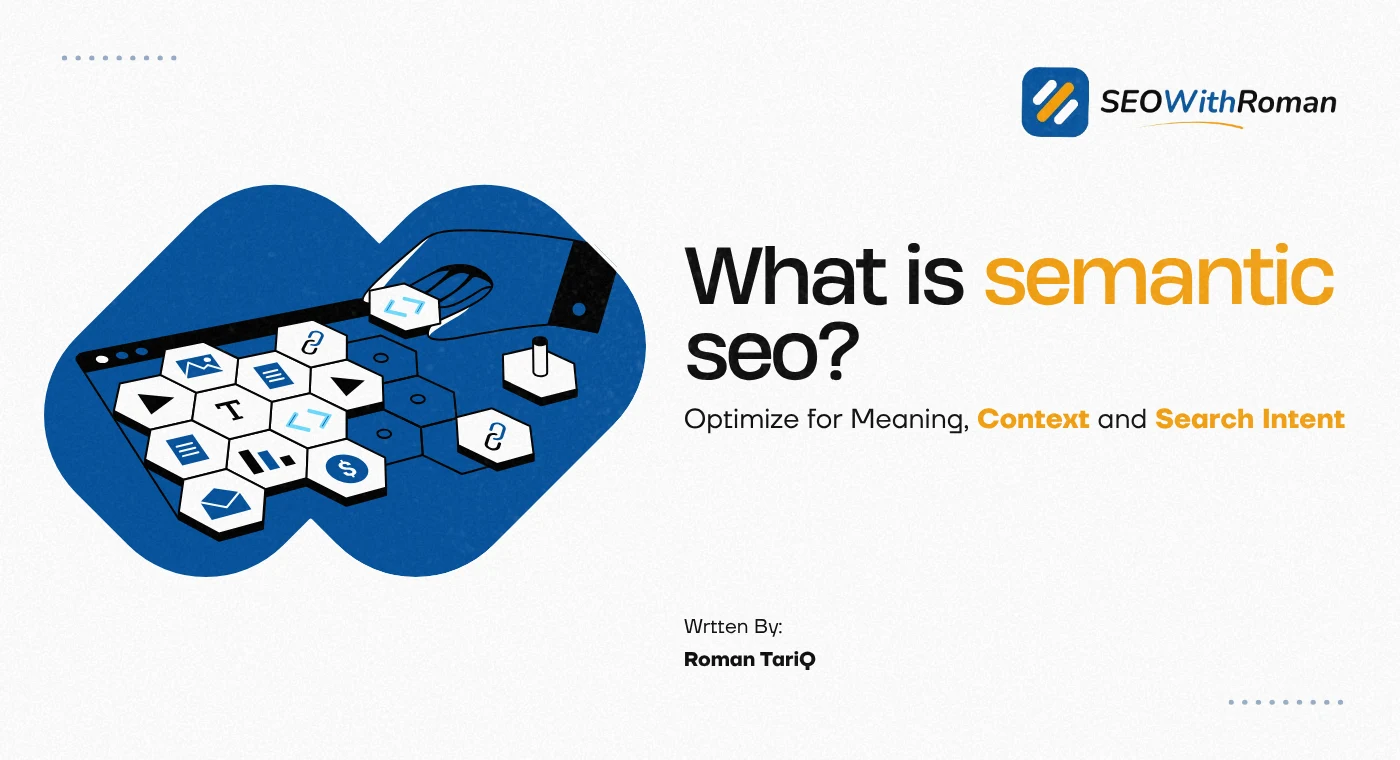
- Semantic SEO means optimizing content around a topic and the intent behind it, not around a single keyword
- Google stopped being a pure keyword matching engine years ago and now ranks pages based on meaning, entities, and context
- You will learn how to build topic clusters, map entities, and use structured data the way search engines actually read it
- This guide also covers how semantic SEO connects directly to showing up in AI Overviews, ChatGPT, and Perplexity answers
- Every section includes something you will not find copy pasted across the other guides on this topic
1 What Is Semantic SEO | The Definition Nobody Explains Properly
Type "semantic SEO" into Google and you will get ten different definitions that all sound roughly the same and explain almost nothing. So let me try to fix that.
Semantic SEO is the practice of creating and structuring content so that search engines understand the meaning behind your words, the relationships between your ideas, and the full scope of a topic, rather than just matching the exact keywords a person typed into the search box.
That is the textbook version. Here is the practical version I give clients.
When you write an article the old fashioned way, you pick one keyword, repeat it a certain number of times, and hope Google notices. That is lexical thinking. You are optimizing for word strings.
When you write using semantic SEO, you start with a question instead. What does someone actually want to know when they search this term, and what related questions, subtopics, and entities would a genuinely knowledgeable person cover to answer it completely? You are optimizing for meaning.
The word "semantic" comes from linguistics, where it simply means "relating to meaning." Apply that to search, and semantic SEO becomes the discipline of aligning your content, your site structure, and even your technical markup with what a topic actually means, not just what it is called.
Semantic SEO not only helps content rank in Google. It's also what determines whether ChatGPT, Perplexity, and Google's AI Overviews choose to cite your page when generating an answer. That's the part most guides on this topic gloss over, and it's the part I care about most when building content strategies for clients in 2026.
Simple example: A traditional SEO page about "best running shoes" might repeat that exact phrase ten times. A semantic SEO page covers the full topic: cushioning types, foot pronation, shoe weight, trail versus road use, brand comparisons, and injury prevention. Google can see that the second page actually understands running shoes as a subject, not just as a phrase to repeat.
2 Semantic SEO vs Traditional SEO | What Actually Changed
I get asked this question constantly by clients who are used to the old playbook: pick a keyword, put it in the title, put it in the first 100 words, repeat it every 200 words, done.
Here is the honest comparison, not the version that makes semantic SEO sound like a magic new category:
| Traditional SEO Approach | Semantic SEO Approach |
|---|---|
| Targets one exact match keyword per page | Targets a topic and its full cluster of related queries |
| Success measured by keyword density | Success measured by topic coverage and intent match |
| Content structured around the keyword | Content structured around the user's actual question |
| Internal linking based on keyword anchors | Internal linking based on entity and topic relationships |
| Optimizes for word matching algorithms | Optimizes for meaning, context, and entity recognition |
| One page competes for one term | One page can rank for hundreds of related terms at once |
Traditional SEO is not dead, and anyone telling you it is trying to sell you something. You still need your primary keyword in your title, your URL, and your first paragraph. What changed is that this is now the floor, not the ceiling.
Google's own search quality documentation makes it clear that ranking systems today are built to understand language contextually rather than matching strings, which is a very different foundation than the search engines most of us grew up optimizing for in 2010.
3 Why Semantic SEO Matters Right Now | Google, RankBrain, and AI Search
Google did not wake up one day and decide to become smarter for fun. This shift happened in stages, and understanding the timeline actually helps you understand what to do about it.
RankBrain (2015) was Google's first serious machine learning system built into its ranking algorithm. Its job was to interpret ambiguous or never before seen queries by connecting them to concepts it already understood, rather than requiring an exact word match.
BERT (2019) took this further. According to Google's own announcement of the update, BERT helped Search understand the full context of a word by analyzing the words before and after it in a sentence, which mattered enormously for longer, conversational queries where small words like "for" and "to" change the entire meaning of a search.
MUM and multimodal search (2021 onward) pushed Google toward understanding queries across formats, languages, and even images, connecting them back to the same underlying concepts.
AI Overviews and generative search (2024 onward) changed the goal again. Now your content is not just being ranked. It is being read, summarized, and sometimes rewritten entirely by an AI system before a user ever clicks through to your site.
Here is why this history actually matters to you. Each of these updates rewarded content that was already thorough, well organized, and genuinely useful, and penalized content that was thin, keyword stuffed, or built to game a specific search term. Semantic SEO is not a new trend to chase. It is the strategy that has been quietly winning through every one of these updates.
4 How Search Engines Actually Understand Meaning
To do semantic SEO well, it helps to understand, at a practical level, what is happening behind the scenes when Google reads your page.
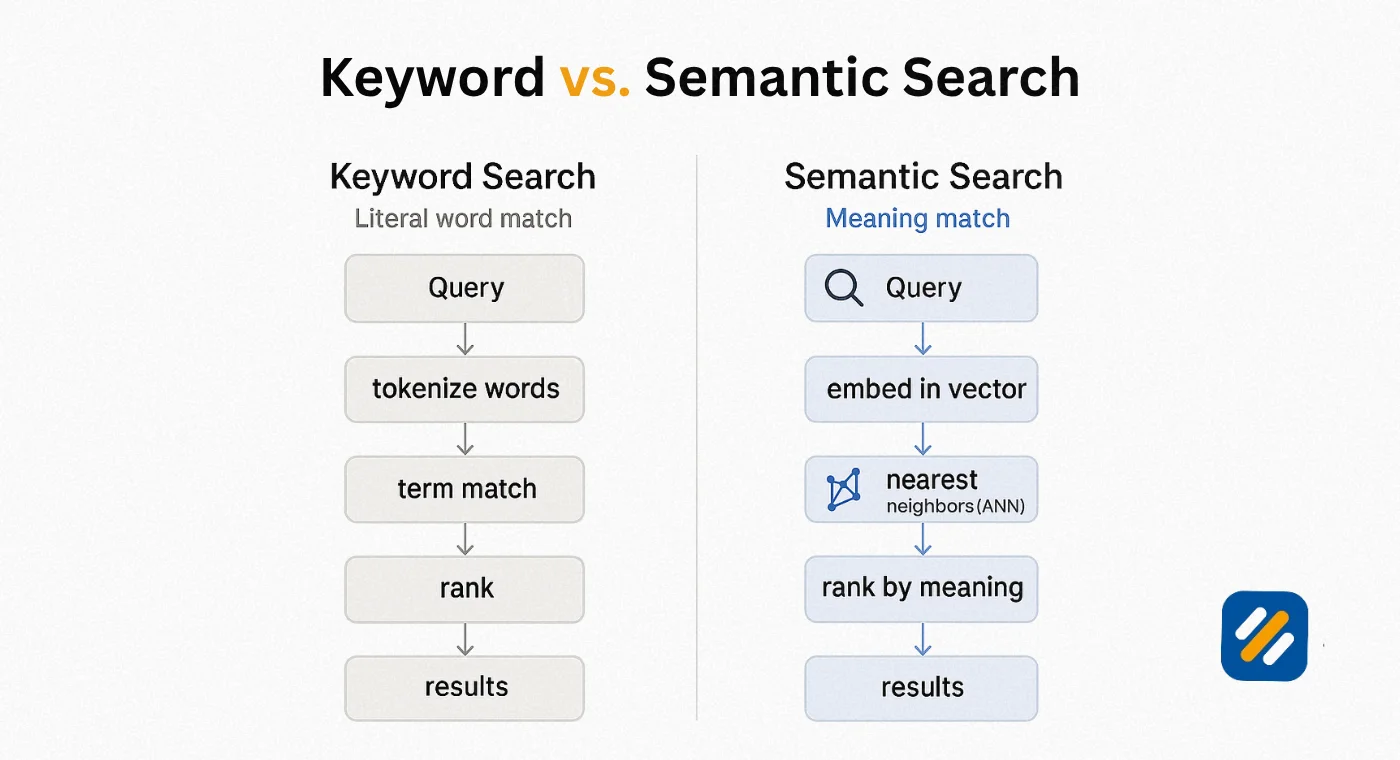
Natural language processing (NLP) is the branch of artificial intelligence that allows machines to interpret human language. It is how Google figures out that "affordable running shoes" and "cheap sneakers for jogging" are conceptually the same search, even though they share almost no words in common.
Vector embeddings are the mathematical layer underneath modern semantic search. Words, sentences, and entire pages get converted into numerical representations, and content with similar meaning ends up positioned closer together in that mathematical space. This is why your page does not need to contain the exact phrase someone searched to be considered relevant. It needs to occupy the right conceptual neighborhood.
The Knowledge Graph is Google's database of real world entities, people, places, organizations, products, and the relationships between them. When you search "Tesla," Google already knows this could mean the car company or the physicist, and it uses contextual signals plus the Knowledge Graph to decide which one you mean and what information to surface.
Google itself is upfront that its systems are not purely semantic. Search still runs on a hybrid model that blends traditional keyword matching with semantic understanding, which is precisely why keywords have not become irrelevant, even as their importance has shifted from being the whole strategy to being one input among many.
5 Search Intent | The Real Foundation of Semantic SEO
If you take one concept away from this entire guide, make it this one. Semantic SEO without search intent is just guessing with extra steps.
Search intent is the actual reason behind a query, the outcome the searcher wants, not just the words they used to get there. Every keyword falls into one of four broad intent categories:
| Intent Type | What the Searcher Wants | Example Query | Content That Wins |
|---|---|---|---|
| Informational | To learn something | "what is semantic seo" | In depth guides, explainers |
| Navigational | To find a specific site or page | "semrush login" | The exact brand page itself |
| Commercial | To research before buying | "best seo tools 2026" | Comparisons, reviews, listicles |
| Transactional | To take an action now | "buy ahrefs subscription" | Product or pricing pages |
Here is the mistake I see constantly, even from experienced marketers. They pick a keyword with decent search volume, write content that matches their own idea of what the topic means, and then wonder why they cannot break into the top ten.
The fix is simple but tedious. Before writing anything, search your target keyword yourself and study the top ranking pages. Not their word count. Not their keyword density. Study what type of content Google is already choosing to reward. If nine of the top ten results are list style comparisons and you are planning a single product review, you are fighting the algorithm's own demonstrated preference, and you will likely lose.
Search intent also shifts over time. A term that was purely informational two years ago can develop commercial intent once enough products enter that space. Revisiting your top pages every few months to confirm the intent has not drifted is a habit that separates SEOs who maintain rankings from SEOs who lose them quietly.
6 How to Build a Semantic SEO Strategy Step by Step
This is the part everyone actually came here for, so let's get into the process I use with client websites across B2B SaaS, healthcare, and ecommerce.
Step 1: Start with a core topic, not a keyword. Instead of picking "semantic seo" as an isolated term, define the broader subject you want your site to be known for. A single keyword gives you one page. A topic gives you an entire content ecosystem.
Step 2: Map the topic using real search data. Pull every keyword variation, question, and related term connected to your core topic using a keyword research tool. Group these by search intent, not just by shared words. Two keywords can look almost identical on the surface and still serve completely different intents.
Step 3: Identify semantically related keywords and entities. These are the concepts a genuine expert would naturally reference when discussing your topic. If you are writing about semantic SEO, a real expert would naturally bring up search intent, topic clusters, schema markup, and the Knowledge Graph without being told to. If your draft does not mention any of these, that's a strong signal the content is shallow.
Step 4: Build your content around a pillar and cluster model. Create one comprehensive pillar page covering the core topic broadly, then build individual cluster pages that go deep on each subtopic. Link them together deliberately, using descriptive anchor text that reflects the actual relationship between the pages.
Step 5: Write for the person, structure for the machine. Your sentences should read like a knowledgeable human explaining something to a friend. Your headings, your schema markup, and your internal linking should be structured cleanly enough that a machine parsing your HTML can map out exactly what your content covers without ambiguity.
Step 6: Reinforce with structured data and internal links. Once the content exists, wrap it in the appropriate schema markup and connect it into your site's broader topical structure through internal links. This step is where a lot of otherwise excellent content quietly underperforms because it was never connected to anything else on the site.
I have used this exact six step process to help a client's technical B2B blog grow from ranking for a few hundred keywords to several thousand within eight months, without a single new backlink, purely by restructuring existing content around topics instead of isolated keywords.
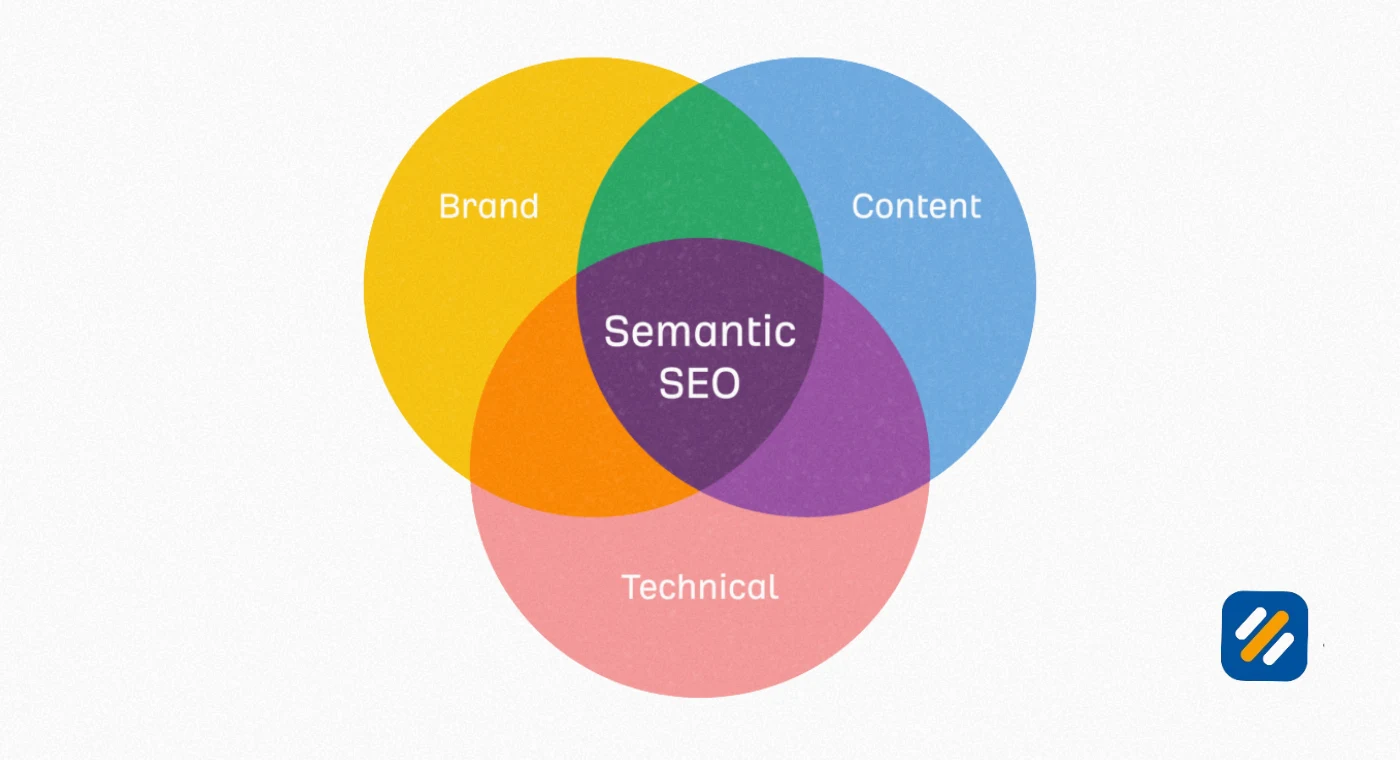
7 Topic Clusters and Topical Authority | Why Google Trusts Some Sites More Than Others
Topical authority is the idea that Google trusts sites that demonstrate deep, consistent coverage of a subject more than sites that touch on a topic once and move on. It is one of the most misunderstood ideas in semantic SEO, so let's clear up the confusion.
Topical authority does not mean writing about every single thing loosely connected to your niche. A site about project management software does not need an article about the history of the pencil just because people used to plan projects with pencils. That is topical bloat, not topical authority, and it dilutes your site's focus rather than strengthening it.
Real topical authority comes from topic clusters, a content structure built around one pillar page and several supporting cluster pages, all interlinked around a shared subject. This structure does two things at once. It helps search engines understand the full depth of what your site covers on that subject, and it helps users navigate naturally from a broad overview into the specific detail they actually need.
Topical relevance is the more granular cousin of topical authority. Where topical authority describes your site's overall standing on a subject, topical relevance describes how closely a single page matches a specific query's meaning. You can have strong topical authority as a site while still publishing a page with weak topical relevance if that particular page fails to address the intent behind its target keyword.
A practical test I use with clients: pull up your site's content on a spreadsheet and group every article by the core entity or subtopic it addresses. If you have twelve articles that all approach the same three subtopics from slightly different angles, and entire relevant subtopics with zero coverage, your topic cluster has gaps that are actively working against your rankings.
8 Entity SEO | Teaching Search Engines Who and What You Are
Entity SEO is the practice of clearly identifying and connecting the people, places, organizations, products, and concepts, known as entities, associated with your brand and content, so that search engines and AI systems can represent them accurately.
This matters more than most SEOs give it credit for. Google's Knowledge Graph does not think in keywords. It thinks in entities and the relationships between them. A brand name on its own carries no inherent meaning to a machine. Apple could mean a fruit or a technology company. Nike could mean a shoe brand or, less obviously, the Greek goddess it was named after. Your job through entity SEO is to remove that ambiguity permanently.
Here's how to actually do this in practice, not just in theory:
Disambiguate your brand explicitly. Use Organization schema markup, a clear About page, and consistent naming across your website and third party profiles so machines never have to guess which entity you are.
Connect your brand to the attributes you want to own. This goes beyond simply mentioning a topic. It means being consistently associated, across your own content and what others say about you, with specific qualities. A cybersecurity company that wants to be known for "zero trust architecture" needs that phrase to appear naturally and repeatedly across its own content, its case studies, and ideally in how other credible sites describe it.
Build out supporting entities around your core topic. If your main entity is "semantic SEO," the supporting entities include search intent, topic clusters, schema markup, and the Knowledge Graph itself. Covering these connected entities within your content, and linking to dedicated pages about each one, strengthens the semantic map search engines build around your primary topic.
Maintain consistency everywhere, not just on your website. Your business name, description, and core attributes should match across your site, your social profiles, directory listings, and any press mentions. Inconsistency creates exactly the kind of ambiguity entity SEO is designed to eliminate.
9 Semantic Keywords and Related Keywords | Finding and Using Them Without Stuffing
Semantic keywords, sometimes still called LSI keywords by older content guides, are terms that are conceptually related to your primary topic, even when they do not share the same root words.
I want to clear up a persistent myth here. LSI, or latent semantic indexing, was a mathematical technique from the 1980s used in information retrieval research. Google has never confirmed using anything called "LSI" in its ranking systems, and the term gets thrown around by content tools far more than it should. What actually matters is simpler: does your content naturally include the vocabulary a real expert would use, including semantically related keywords, related keywords, and adjacent concepts, when covering this topic thoroughly?
Practically, here is how to find and use them:
Study the language, not just the volume. Look at how top ranking pages, forums, and even video transcripts on your topic naturally discuss it. You are looking for recurring concepts and terminology, not just keyword variations.
Group semantically related keywords by subtopic, not by search volume. A keyword with modest search volume can represent an essential subtopic your content would be incomplete without.
Weave them into your content the way a subject matter expert would talk, not the way a keyword tool lists them. If a sentence reads awkwardly because you forced a term into it, that sentence has failed both the reader and the algorithm.
Avoid keyword stuffing entirely. Google's algorithms have gotten good enough at understanding synonyms and related concepts that repeating your exact primary keyword excessively provides no additional ranking benefit and actively damages readability, which in turn damages engagement signals.
The goal is content so thorough on its subject that the right related keywords appear naturally, not because you forced them in, but because you genuinely could not write a complete answer to the topic without mentioning them.
10 Schema Markup | The Structured Data Layer of Semantic SEO
Schema markup is a standardized vocabulary of tags, maintained through Schema.org, that you add to your website's code to explicitly tell search engines what each piece of content means, rather than leaving them to infer it.
Think of schema as a translation layer. Without it, a search engine has to guess whether the numbers on your page represent a price, a rating, or a phone number. With proper schema markup, you tell it directly.
Here is where schema fits specifically into semantic SEO, beyond just enabling rich snippets in search results:
Article schema helps confirm authorship, publish dates, and the structured relationship between your headline and body content, which supports both freshness signals and E-E-A-T evaluation.
FAQ and HowTo schema structure question and answer or step by step content in a format that AI Overviews and voice assistants can extract cleanly, which matters enormously if visibility in generative search results is part of your strategy.
Organization and Person schema directly support entity SEO by giving search engines explicit, machine readable confirmation of who is publishing the content and what their credentials are.
BreadcrumbList schema reinforces your site's information architecture, helping search engines understand exactly how a page fits into your broader topic cluster.
Google's own developer documentation confirms that structured data helps its systems understand page content more thoroughly, which is precisely why schema deserves a place in any semantic SEO strategy, not as an optional extra, but as a core technical layer.
One caution worth repeating from experienced technical SEOs: never mark up content with schema that does not actually exist on the page. Google's guidelines are explicit that structured data must reflect visible, accurate content, and inaccurate markup can trigger manual actions rather than rich result eligibility.
11 Semantic SEO Best Practices and Techniques | The Complete Checklist
Pulling everything together, here are the semantic SEO best practices I actually apply on client projects, organized by category so you can audit your own site against them.
| Category | Semantic SEO Technique | Why It Works |
|---|---|---|
| Content Strategy | Build pillar and cluster content around topics, not keywords | Demonstrates topical authority to search engines |
| Content Strategy | Match content format to demonstrated search intent | Aligns with what Google has already shown it rewards |
| On-Page | Use descriptive, question based subheadings | Helps both readers and AI systems parse content structure |
| On-Page | Answer the core question within the first two sentences | Supports featured snippets and AI Overview extraction |
| Keywords | Include semantically related keywords naturally throughout | Signals genuine topic depth rather than surface coverage |
| Technical | Implement Article, FAQ, and Organization schema | Gives search engines explicit, unambiguous context |
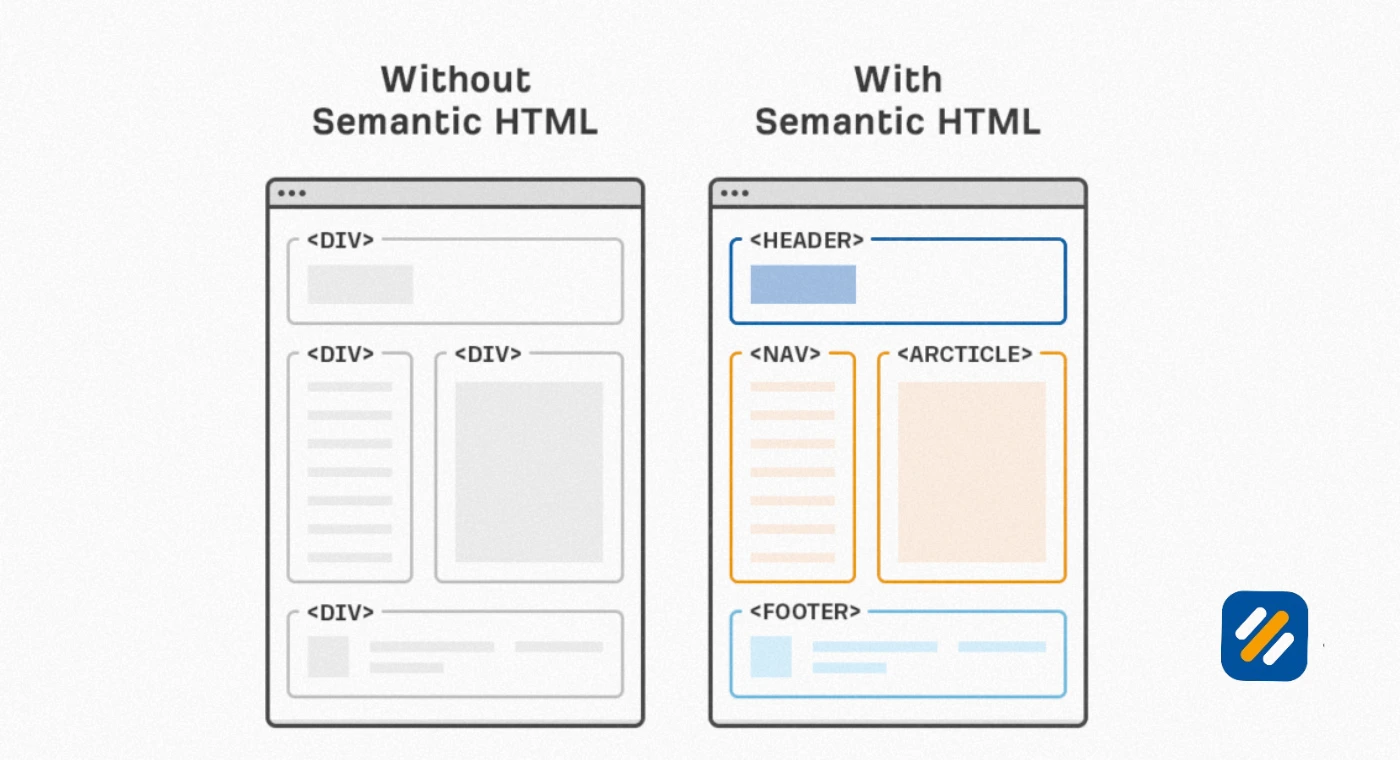
| Technical | Use semantic HTML tags instead of generic divs | Improves how both crawlers and assistive technology parse pages |
| Linking | Interlink cluster pages using descriptive anchor text | Reinforces topic and entity relationships across the site |
| Linking | Link out to authoritative sources where relevant | Supports E-E-A-T and trustworthiness signals |
| Branding | Maintain consistent entity naming across the web | Reduces ambiguity in how machines represent your brand |
Treat this as a working checklist rather than a one time task. Semantic SEO is not something you finish. It is a standard you maintain as your content library grows and as search engines continue refining how they interpret meaning.
12 Semantic SEO for AI Overviews and Generative Engine Optimization (GEO)
Here is where semantic SEO stops being theoretical and starts directly affecting whether you get cited by ChatGPT, Perplexity, and Google's AI Overviews.
Generative engines do not rank ten blue links. They synthesize an answer from multiple sources and, in the better systems, cite where that information came from. To get selected as a source, your content needs to satisfy the same underlying requirement semantic SEO has always demanded: clear, well structured, unambiguous coverage of a specific topic.
A few specific adjustments matter here beyond standard semantic SEO practice:
Write extractable answers. AI systems favor content where a complete, self contained answer to a specific question sits within a tight paragraph or two, rather than being spread thin across an entire page.
Strengthen entity clarity even further. Generative engines are more likely to cite sources they can confidently attribute to a known, disambiguated entity, which loops directly back to the entity SEO work covered earlier in this guide.
Keep factual claims verifiable and sourced. AI systems increasingly weigh whether a claim can be corroborated elsewhere on the web. Original data, named case studies, and clear sourcing all increase the odds your content gets treated as a trustworthy citation rather than skipped over.
Do not abandon traditional ranking factors. Being cited in an AI Overview and ranking organically are not separate strategies. In most cases I have tracked, pages that already rank well organically for a query are the same pages most frequently pulled into the AI generated answer above them.
GEO is a newer term, but it is not a separate discipline from semantic SEO. It is what happens when you apply the same principles, clarity, structure, entity precision, and genuine topical depth, to a search environment where the audience reading your content might be an algorithm summarizing it for someone else.
13 Common Semantic SEO Mistakes to Avoid
After reviewing dozens of client sites over the years, the same mistakes show up again and again. Here are the ones worth watching for specifically.
Confusing topical breadth with topical authority. Publishing fifty loosely related articles is not the same as building genuine depth on a subject. Quality of coverage matters more than quantity of pages.
Treating semantic keywords as a checklist to stuff in. If you are pasting a list of related terms into your draft and force fitting them, you have missed the entire point of writing content the way a genuine expert would.
Ignoring internal linking after publishing. A brilliant piece of content that sits isolated from the rest of your site, with no links in or out, sends a weak topical signal regardless of how well it is written.
Adding schema markup that does not match visible content. This is both a wasted effort and a potential policy violation, since structured data is meant to describe what is actually on the page.
Skipping search intent validation before writing. Writing a comprehensive guide for a keyword that Google has clearly decided deserves a short, direct answer is effort spent working against the algorithm rather than with it.
14 3 Expert Tips to Get More Out of Semantic SEO
Tip 1: Build your topic cluster map before you write a single article. Most people build topic clusters retroactively, realizing months later that their content is scattered. Instead, spend one afternoon mapping your entire pillar and cluster structure in a spreadsheet before writing anything. You will publish faster once you start, because every piece already has a defined place and purpose.
Tip 2: Audit your top pages for entity gaps twice a year. Pull your best performing pages and check whether they explicitly mention the core entities and related concepts a true expert on that subject would reference today. Search behavior and terminology shift, and content that was semantically complete eighteen months ago often has quiet gaps now.
Tip 3: Read your content out loud before publishing. This sounds unrelated to technical SEO, but it is one of the most reliable ways to catch keyword stuffing and awkward semantic keyword insertion. If a sentence sounds strange spoken aloud, it will read as unnatural to both users and the language models evaluating it.
15 Research and Documentation Behind Semantic SEO
Rather than asking you to take these concepts on faith, here is where to verify the underlying mechanics directly from primary sources:
| Source | What It Covers | Link |
|---|---|---|
| Google Search Central | Official documentation on how structured data helps Google understand pages | developers.google.com/search/docs/appearance/structured-data |
| Google Blog | The original announcement explaining how BERT interprets word context and search intent | blog.google/products/search/search-language-understanding-bert |
| Schema.org | The official structured data vocabulary used across major search engines | schema.org |
| Google Knowledge Graph | Technical documentation on how Google's entity database works | developers.google.com/knowledge-graph |
| Google Search Quality Rater Guidelines | The official document defining E-E-A-T and how quality raters evaluate content | Search Quality Rater Guidelines PDF |
Bookmark these. Content tools and blog posts, including this one, will always be secondary interpretations. The primary documentation is where the actual rules live.
16 Conclusion
Semantic SEO is not a separate category of search engine optimization you bolt onto your existing strategy. It is what SEO becomes once you stop optimizing for a search engine's older, cruder way of reading the web and start optimizing for how it actually reads content today, through meaning, entities, and intent.
The sites that will keep winning through the next round of algorithm updates, and the ones already earning citations inside AI Overviews, are not doing anything mysterious. They are covering topics thoroughly, structuring that coverage clearly, connecting it through deliberate internal linking, and backing it with clean structured data.
Start with one pillar topic. Map its cluster. Write the content the way a genuine expert would explain it to someone who asked in person. The technical layer, schema, internal links, entity consistency, exists to support that content, not replace the work of actually understanding your subject.
Have a question about building a semantic SEO strategy for your own site? Drop a comment below and I will answer it personally.
Join 1,000+ business owners and bloggers who get one actionable SEO tip every week — straight to their inbox. Free forever.
Get Free Weekly Tips →