- Generative Engine Optimization (GEO) is the practice of optimising your content and brand presence to appear inside AI-generated answers, not just traditional search results
- GEO does not replace SEO. It extends it. The same content quality, authority signals, and technical foundations that drive SEO success also drive GEO visibility
- AI search engines like ChatGPT, Perplexity, Google AI Overviews, and Claude pull from the same internet your existing content lives on
- Content with statistics, direct quotes, clear definitions, and structured formatting consistently performs better in AI-generated responses
- Brand mentions across authoritative platforms, even without links, carry significant weight in how LLMs reference and recommend brands
1 What Is Generative Engine Optimization and Why Every Marketer Needs to Understand It Right Now
Something fundamental changed in how people search for information. It did not happen overnight but by 2024 it had become impossible to ignore.
When someone types a question into Google today, they often see an AI-generated answer at the very top of the page before a single website link appears. When someone asks ChatGPT which accounting software to use for their small business, they get a synthesised recommendation pulled from dozens of sources across the web. When a potential client searches Perplexity for the best Customer service companies in the United States, they see a generated response that names specific brands, compares options, and suggests a decision.
In every one of those scenarios, some brands get mentioned and recommended. Others do not exist in the answer at all, regardless of how well their website ranks on traditional Google.
Generative Engine Optimization, or GEO, is the practice of optimising your content, brand presence, and digital footprint so that AI-powered search systems include you in the answers they generate for your target audience.
The term was formally defined in a Princeton University research paper published in 2023, which analysed how different content strategies affected visibility in AI-generated responses across 10,000 real-world queries. The findings confirmed what many SEO specialists had already begun to observe in practice: the rules for AI visibility are both similar to and importantly different from traditional search optimisation.
After many years of working on SEO campaigns for US and UK businesses, I can tell you that GEO is not a replacement for anything you are already doing. It is the next layer of a strategy that started with on-page SEO, expanded into technical SEO, and now extends into how AI systems perceive, reference, and recommend your brand.
2 How AI Search Engines Actually Work | What GEO Is Really Optimising For
To optimise for AI-generated search results, you first need to understand how these systems actually produce their answers. This is where most GEO guides fall short. They tell you what to do without explaining why it works.
AI search engines like ChatGPT Search, Perplexity AI, and Google AI Overviews are built on large language models, or LLMs. An LLM is a type of AI trained on enormous amounts of text data from across the internet. During training, the model learns patterns, facts, relationships between concepts, and which sources tend to be associated with authoritative information on specific topics.
When a user asks an AI search engine a question, two things happen simultaneously. First, the LLM draws on its training data to understand the question and form a response framework. Second, the system retrieves live web content through a process called retrieval-augmented generation, or RAG. This retrieval step is where your content has the opportunity to be pulled directly into the generated answer.
The AI then synthesises training knowledge with retrieved content and produces a response. It decides which sources to cite, which brands to mention, and how to frame the answer based on factors including content relevance, source credibility, content freshness, and how clearly the content answers the specific question.
Here is the critical insight for GEO strategy. You are not trying to rank in a list. You are trying to be the source the AI chooses to synthesise and cite. That requires a different kind of optimisation than putting a keyword in a title tag.
3 GEO vs SEO vs AEO | Understanding the Full AI Search Landscape
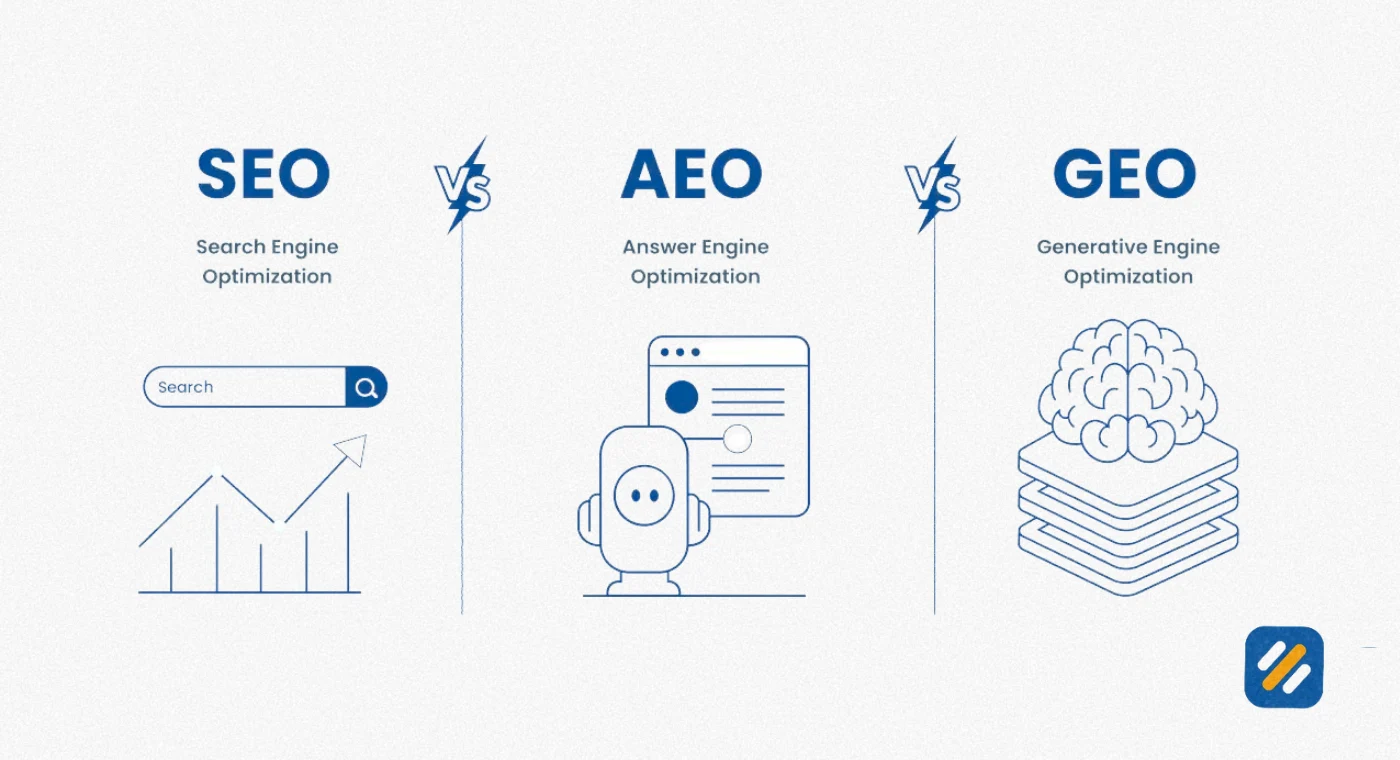
The terminology around AI search optimisation is still evolving rapidly. GEO, SEO, AEO, and LLM optimisation are terms that often get used interchangeably when they actually describe distinct but overlapping practices.
| Term | Full Name | What It Optimises For | Primary Platforms |
|---|---|---|---|
| SEO | Search Engine Optimisation | Rankings in traditional search results | Google, Bing organic results |
| GEO | Generative Engine Optimisation | Visibility in AI-generated responses and answers | ChatGPT, Perplexity, Google AI Overviews, Claude |
| AEO | Answer Engine Optimisation | Featured snippets, People Also Ask, voice search answers | Google featured snippets, Alexa, Siri |
| LLM Optimisation | Large Language Model Optimisation | How your brand is represented in AI model training data | All LLM-based platforms |
| AI Search Optimisation | Broad term covering GEO and AEO | All forms of AI-powered search visibility | All AI search platforms |
| Semantic SEO | Semantic Search Optimisation | Topical authority and entity relationships | Google Knowledge Graph, all semantic search |
The most important relationship to understand is between GEO and SEO. They are not competing strategies. SEO focuses on helping you appear in search engine results pages, while GEO focuses on helping you appear within AI-generated answers. But the foundations are shared. Strong content, technical accessibility, and authoritative backlinks serve both goals simultaneously.
AEO, or answer engine optimisation, is an older concept that focused on winning featured snippets and voice search answers. GEO builds on AEO principles but extends them to the more complex, multi-source synthesis that modern AI search engines produce.
4 Why GEO Matters More Than Most Businesses Currently Realise
The numbers behind AI search adoption are difficult to ignore for anyone planning a digital marketing strategy for 2026 and beyond.
ChatGPT hit 100 million users faster than any app in history. Google's AI Overviews now reach billions of users each month. Perplexity reported over 15 million daily active users in early 2025. Microsoft's Copilot is integrated directly into Windows and Office products used by hundreds of millions of people worldwide.
What this adoption means in practice is that a significant and growing portion of your potential customers are getting their first impression of your brand, your competitors, and your industry through an AI-generated answer rather than through a traditional search result they clicked on themselves.
There are two types of businesses in this landscape. Those that appear in AI-generated answers and those that do not. The ones that appear become part of the consideration set before the buyer has even visited a website. The ones that do not appear are effectively invisible to that portion of the market.
Here is what GEO visibility means in practical business terms
- When a US small business owner asks ChatGPT for the best SEO consultant to hire, your name or brand has an opportunity to appear in that answer
- When a UK ecommerce manager asks Perplexity to compare BPO providers, your company can be in the synthesised response
- When a blogger asks Google AI Overviews how to do keyword research for free, your tutorial can be cited as the source
None of these scenarios require the user to search for your brand by name. GEO puts you in front of people at the exact moment they are forming a decision, even when they have never heard of you before.
5 The Core GEO Strategy | What Actually Gets You Cited in AI Answers
The most important question in all of GEO is: what makes an AI search engine choose your content as a source?
Research from Princeton University analysed this question across 10,000 real search queries and identified specific content characteristics that consistently increased AI visibility. Pages containing quotes and statistics had 30 to 40 percent higher visibility in AI responses compared to content without them.
Beyond that specific finding, here is what the full body of GEO research and practical experience confirms works
Clear, direct definitions at the start of each topic: AI systems need to extract information efficiently. Content that defines its core concepts in the first sentence of each section is far more likely to be pulled into an AI response than content that builds to the definition after several paragraphs of context.
Original statistics and cited data: AI systems are trained to prefer factual, verifiable content. When your content contains specific numbers, studies, or original research, it signals the kind of authoritative sourcing that LLMs are designed to prioritise.
Structured, scannable formatting. Tables, numbered lists, and clearly labelled headings make it easier for AI retrieval systems to extract specific pieces of information. Prose buried in long unbroken paragraphs is harder for AI systems to parse and less likely to be included in generated answers.
Topical depth and breadth: AI systems tend to reference sources that cover a topic comprehensively rather than sources that cover one narrow angle. A complete guide that answers the main question and every related question a reader might have is more valuable to an AI synthesis engine than a short article that answers only the headline question.
Brand mentions across multiple independent sources: AI systems may give brand mentions more weight even when they are not linked. When multiple independent websites, forums, social platforms, and publications mention your brand in the context of a specific topic, the LLM associates your brand with that topic more strongly.
6 GEO Best Practices | The Complete Step by Step Implementation Guide
Here is the exact GEO strategy I apply when optimising content for AI search visibility alongside traditional SEO
Step 1: Write for extractability first
Before you think about keyword density or internal links, ask yourself: if an AI system wanted to extract one clear answer from this section, could it do so in two sentences or less? Structure every section to answer its heading question directly and immediately. The depth comes after the direct answer, not before it.
Step 2: Add a clear definition for every key concept
Every major term or concept in your article should have a one-sentence definition that an AI can lift directly into a generated response. Write it as: "X is Y that does Z." This format is exactly what AI systems are looking for when they need to explain a concept to a user.
Step 3: Include original data, statistics, and cited research
Reference published studies, link to original research, and where possible conduct and publish your own data. Even simple original research like "I analysed 50 client websites and found that..." creates a unique data point that AI systems can cite as a source no other article provides.
Step 4: Build topical authority through content clusters
AI systems build associations between brands and topics based on the breadth and depth of content they find across the web. Publishing 30 articles all related to SEO for beginners builds a stronger topical association than publishing 30 articles across 15 unrelated topics. Topic clustering is both an SEO and a GEO strategy simultaneously.
Step 5: Earn mentions on authoritative platforms
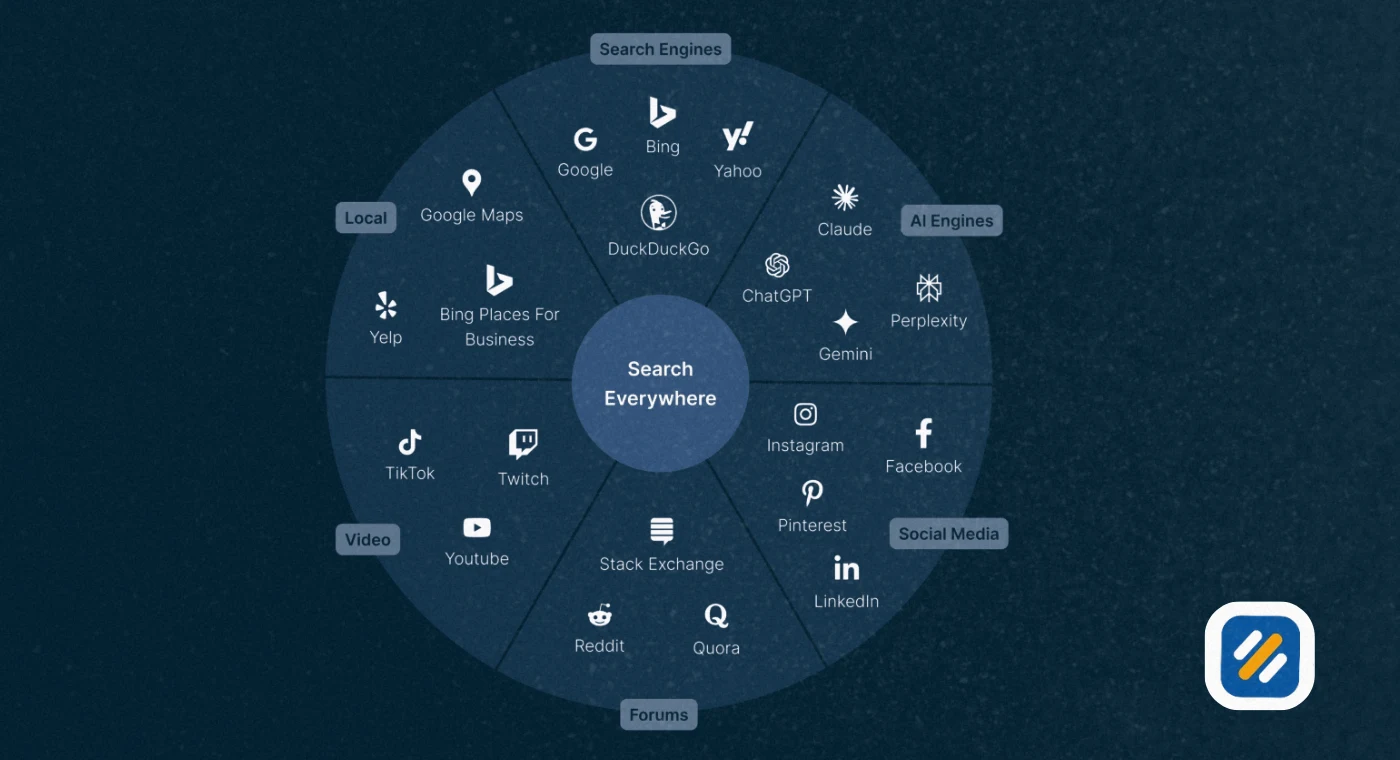
Platforms that allow user-generated content such as Reddit, YouTube, and Facebook appear to have high exposure in generative engines. Getting your brand discussed on Reddit threads, referenced in YouTube videos, and mentioned in industry forums creates the kind of distributed brand presence that LLMs associate with genuine authority.
Step 6: Ensure your content is technically accessible to AI crawlers
AI crawlers seem to have trouble executing JavaScript, so your content might be invisible if it relies heavily on client-side rendering. Use server-side rendering where possible, ensure your pages load without JavaScript dependency for their core content, and keep your robots.txt file from accidentally blocking AI crawler access.
Step 7: Keep your content fresh and updated
Fresh content is often favoured by AI tools. Update your most important articles at least every six months. Add a "last updated" date that is visible on the page. AI systems want to provide current information and they use content freshness as a proxy for accuracy.
7 GEO and Semantic SEO | The Connection Most People Miss
One of the most underappreciated aspects of GEO strategy is its relationship with semantic SEO. Understanding this connection can dramatically accelerate your AI visibility without requiring entirely new content creation.
Semantic SEO is the practice of optimising for the relationships between topics, entities, and concepts rather than individual keywords. It involves covering a topic so comprehensively that Google's Knowledge Graph and other semantic systems associate your website with that topic at an entity level.
GEO benefits from exactly the same approach because LLMs are essentially semantic systems at their core. They do not think in keywords. They think in concepts, entities, and relationships. A website that Google's semantic systems recognise as an authority on SEO for beginners is the same website that ChatGPT's training data associates with expertise on that topic.
This means your semantic SEO investment pays dividends in both traditional search and AI search simultaneously. Here is how to apply it practically
Cover your primary topic from every meaningful angle. For an SEO blog, this means publishing on keyword research, on-page optimisation, technical SEO, backlinks, local SEO, WordPress SEO, and free tools. Each article strengthens the semantic association between your domain and the broader topic of SEO.
Use entity-based language naturally. Mention real tools, real platforms, real people, and real companies by name throughout your content. LLMs build entity relationships from this kind of specific, real-world language.
Answer the full question spectrum. For any topic you cover, think about what a complete beginner would ask, what an intermediate practitioner would ask, and what an advanced user would ask. Covering all three levels signals comprehensive expertise to both semantic search systems and LLMs.
8 AI Search Engines and LLMs | Which Platforms Your GEO Strategy Should Target
Not all AI search platforms are equal in terms of user volume, behaviour, or the content signals they prioritise. Understanding each platform helps you focus your GEO efforts where they will have the most impact.
| Platform | User Base | How It Sources Content | Key GEO Signal |
|---|---|---|---|
| Google AI Overviews | Billions monthly | Live web crawl plus Google's existing index | Strong existing Google SEO rankings |
| ChatGPT Search | 100M+ users | Live Bing web search plus training data | High domain authority, fresh content |
| Perplexity AI | 15M+ daily users | Live web crawl, heavily cites sources | Authoritative, well-structured content |
| Microsoft Copilot | Hundreds of millions via Windows | Bing web search | Content indexable by Bing crawler |
| Claude AI | Millions of users | Training data plus operator-provided context | Brand mentions on authoritative platforms |
| Google Gemini | Hundreds of millions | Google index plus live search | Strong E-E-A-T signals, Google trust |
For most small businesses and personal brand websites targeting US and UK audiences, the priority order is Google AI Overviews first, ChatGPT Search second, and Perplexity AI third. These three platforms account for the vast majority of AI-generated search interactions in English-speaking markets.
The good news is that the same content optimisation that improves your visibility in Google AI Overviews will generally improve your visibility across all three platforms because they all prioritise the same core signals: relevance, authority, freshness, and clarity.
9 How to Measure Your GEO Performance and AI Visibility
One of the biggest differences between SEO and GEO right now is measurement. Traditional SEO has decades of established metrics and tools. GEO measurement is still developing but the core things to track are clear.
AI mention tracking: Manually search your brand name and key topics in ChatGPT, Perplexity, and Google AI Overviews. Note whether your brand is mentioned, how it is described, and whether your content is cited as a source. Do this monthly and record the results in a simple spreadsheet.
Citation tracking: When AI systems do cite your content, they usually include a link or attribution. Tools like Ahrefs and Google Search Console will show you referral traffic from AI platforms as these platforms grow. Track these referral sources separately from your regular organic traffic.
Brand sentiment in AI responses: It is not enough to just be mentioned. How you are described matters enormously. If an AI system consistently describes your brand as "a small blog" rather than "an expert resource," that framing influences how users perceive and trust the recommendation. Track not just whether you are mentioned but how you are positioned.
Share of voice in AI answers: For any topic you are targeting, track how often your brand appears in AI-generated answers compared to competitors. Even informal manual tracking of this metric monthly gives you directional data on whether your GEO strategy is working.
For paid tool tracking, Semrush's AI Visibility Toolkit and Ahrefs' brand monitoring features both offer AI-specific visibility tracking that automates much of this process.
10 GEO for Personal Brand Websites | How to Build AI Visibility as an Individual Expert
Everything discussed so far applies directly to large brand websites. But for personal brand websites and individual experts, GEO offers a specific and underused opportunity.
LLMs are trained to associate named individuals with their areas of expertise when those individuals have a consistent, credible presence across multiple authoritative sources. A named SEO specialist with published articles on an established blog, a LinkedIn profile with detailed professional history, mentions in industry publications, and a consistent track record of accurate published information is exactly the kind of entity an LLM learns to recognise and reference.
Here is how to build personal brand GEO visibility specifically
Use your full name consistently across every platform. Your author bio, LinkedIn profile, Twitter or X profile, guest post bylines, and podcast appearances should all use the same version of your name so LLMs can build a consistent entity association.
Publish under your name on your own website consistently. Every article you publish on SEOWithRoman.com strengthens the association between your name and SEO expertise in the training data and live crawl results that AI systems use.
Get mentioned on platforms LLMs heavily reference. Wikipedia, Reddit, Quora, YouTube, and industry publications all carry high weight in LLM training data. A mention in a Reddit thread about the best SEO blogs, a Quora answer you wrote that gets upvoted, or a guest post on an established SEO publication all contribute to your personal brand's AI visibility.
Build a clear, expertise-focused author bio. Every article on your website should have an author bio that states your name, your years of experience, your specific expertise, and your professional track record. This bio is directly readable by AI crawlers and contributes to how LLMs understand and represent your expertise.
11 3 Expert GEO Tips That Go Beyond What Most Guides Cover
Tip 1: Write "Definition Paragraphs" at the Top of Every Section
The single highest-impact GEO tactic I have found is starting every H2 section with a one or two sentence direct definition or answer. AI systems extract these definition paragraphs constantly. When your article defines "what is generative engine optimisation" in a single clear sentence at the top of the relevant section, that sentence has a significantly higher chance of appearing verbatim or near-verbatim in an AI-generated response than any other part of your article.
Tip 2: Build Your "Entity Footprint" Across Platforms Before Expecting AI Mentions
Most people publish content and then wonder why AI systems are not mentioning their brand. The answer is almost always that the brand has no meaningful entity footprint. Before AI systems will reference you, they need to encounter your name and brand in multiple independent contexts. Prioritise getting three to five meaningful mentions on platforms LLMs heavily index, Reddit, Quora, LinkedIn articles, and industry directories, before expecting consistent AI visibility from your content alone.
Tip 3: Update Your Best Articles Every Quarter With Fresh Data
AI systems heavily favour fresh content because their users expect current information. An article last updated in 2023 competes at a significant disadvantage against an equivalent article updated in 2026 for AI-generated answer inclusion. Pick your five best performing articles and commit to updating each one every quarter with fresh statistics, updated tool recommendations, and new examples. This single habit consistently outperforms publishing new articles in terms of AI visibility impact per hour of work invested.
12 GEO vs SEO | Will AI Search Replace Traditional Google Rankings
This is the question I get asked most frequently by clients who have discovered GEO and immediately start wondering whether their existing SEO investment is about to become obsolete.
The honest answer, based on both current data and fundamental understanding of how these systems work, is no.
GEO is not replacing SEO. It complements it. SEO aims to improve your visibility in organic search results. GEO aims to improve your appearance in AI-generated answers. Most brands need both for a comprehensive search visibility strategy.
Here is the practical reality. AI Overviews appear on only a portion of Google searches. Informational queries trigger AI answers most frequently. Transactional queries, local queries, and navigational queries still predominantly show traditional organic results. The person searching "buy running shoes near me" is still seeing a map pack and product listings, not an AI-generated essay on running shoe selection.
Additionally, AI search systems themselves rely on traditional web content as their source material. They cannot generate accurate, current answers without crawling and indexing the same websites that Google indexes. This means the website authority, content quality, and technical SEO foundation you build for Google rankings directly supports your AI visibility at the same time.
The brands that will win in search over the next five years are the ones that treat SEO and GEO as one integrated strategy rather than competing approaches. Build great content. Make it technically accessible. Earn genuine authority. Do all of that consistently and both traditional and AI search will reward you over time.
13 Conclusion
Generative Engine Optimization is not a future trend. It is happening right now, and the brands that understand it earliest are building AI visibility advantages that will compound over the next three to five years exactly the way early SEO adopters built organic traffic advantages in the early 2010s.
The core of a strong GEO strategy is not complicated. Write genuinely useful content that defines concepts clearly, backs claims with data, covers topics comprehensively, and keeps information current. Make sure AI crawlers can access that content technically. Build your brand presence across the platforms that LLMs use as authoritative sources.
If you have been doing solid SEO for any length of time, you are already much closer to strong GEO performance than you realise. The additional steps are not a reinvention of your strategy. They are an evolution of it.
Start by searching your brand name and your primary topic in ChatGPT and Perplexity today. See what comes up. That search result is your GEO baseline, and every piece of quality content you publish from this point forward is a step toward improving it.
Have a question about GEO or AI search visibility? Leave a comment below and I will answer it personally.
Join 1,000+ business owners and bloggers who get one actionable SEO tip every week — straight to their inbox. Free forever.
Get Free Weekly Tips →