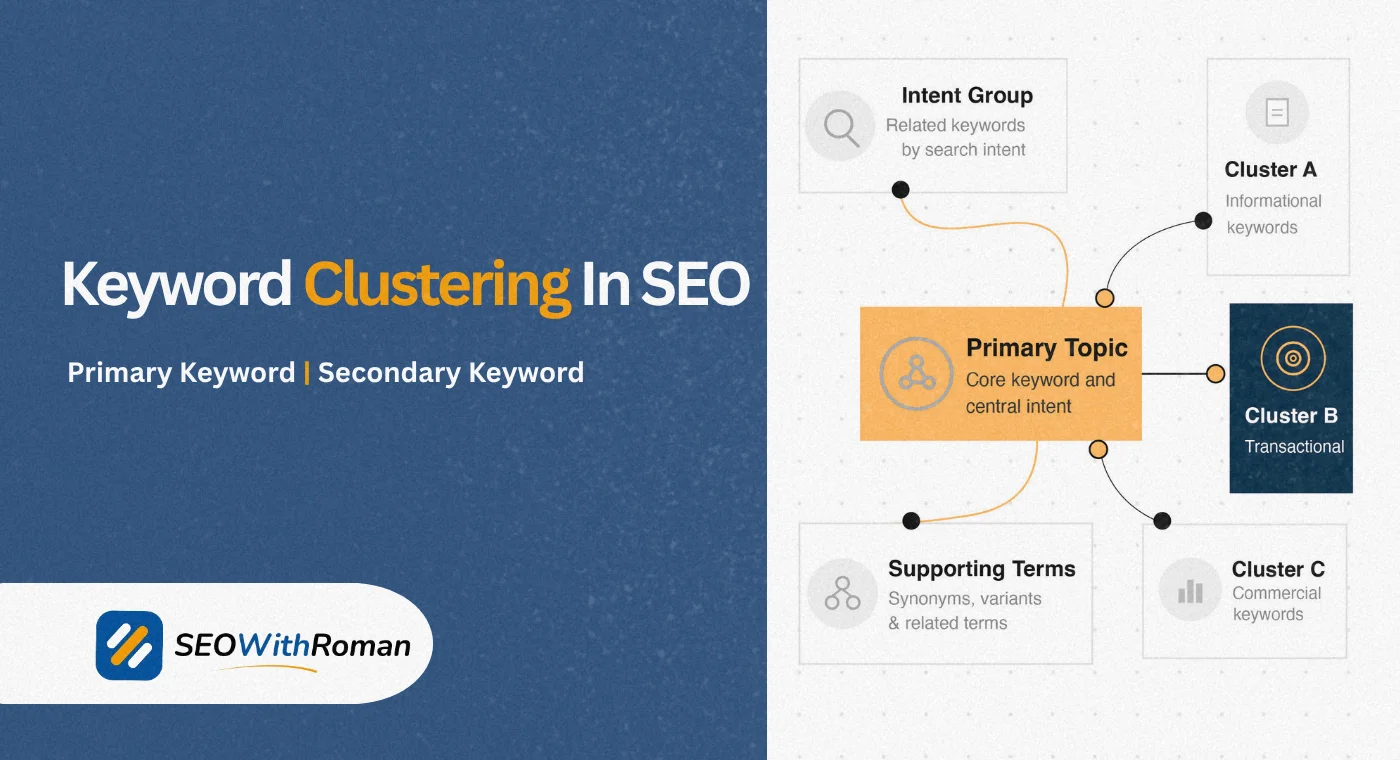
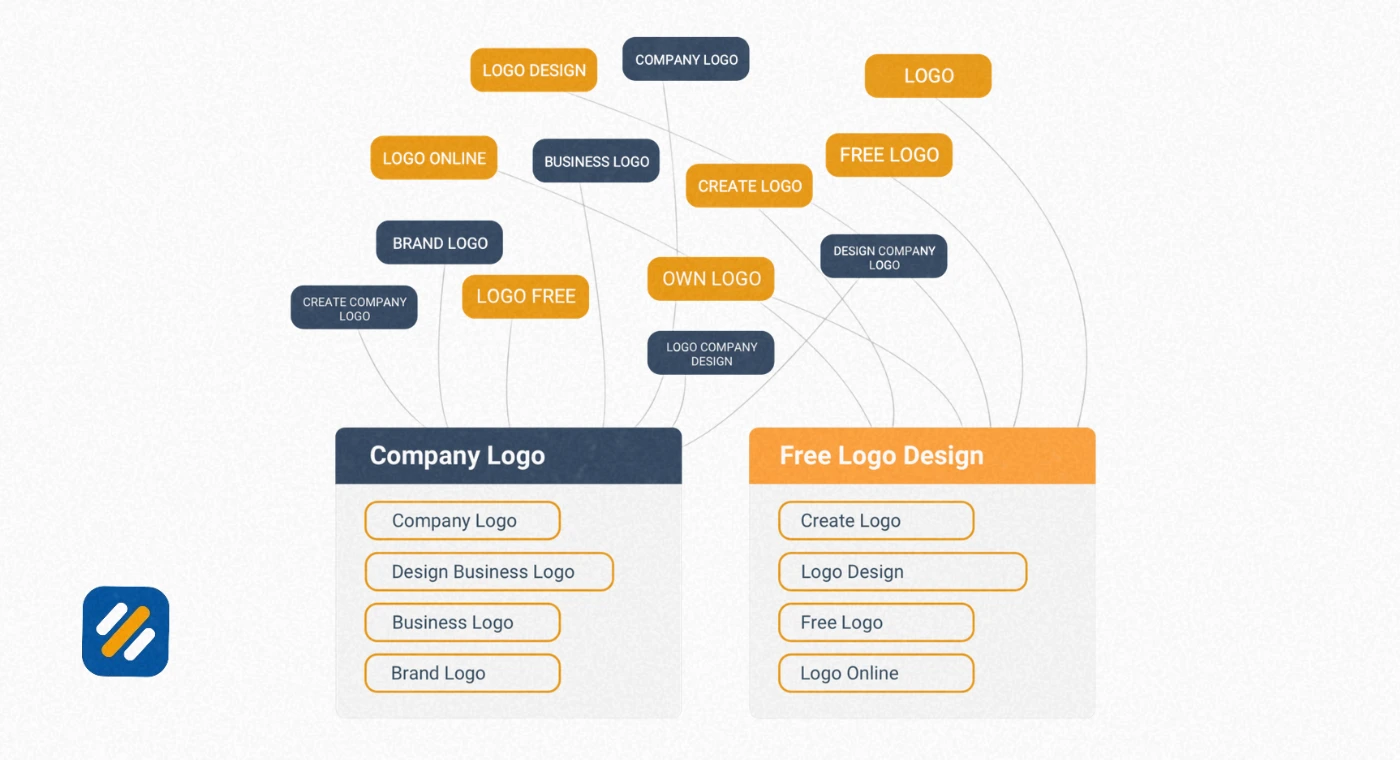
- Keyword clustering is the process of grouping keywords with the same search intent so one page can rank for all of them simultaneously
- A single well-clustered page can rank for hundreds of related keywords and generate significantly more traffic than targeting one keyword per page
- There are two methods for clustering keywords: manual SERP analysis and automated tools like Semrush and Ahrefs
- Search intent is the foundation of every keyword cluster. Keywords with different intents must always be targeted on separate pages
- Keyword clustering also helps your content appear in Google AI Overviews and AI search platforms like ChatGPT and Perplexity
1 What Is Keyword Clustering and Why It Changes How You Think About SEO
Most beginners approach SEO the same way. One keyword. One page. Repeat until you have hundreds of pages each targeting a single term. It feels logical. It is actually one of the biggest efficiency mistakes you can make.
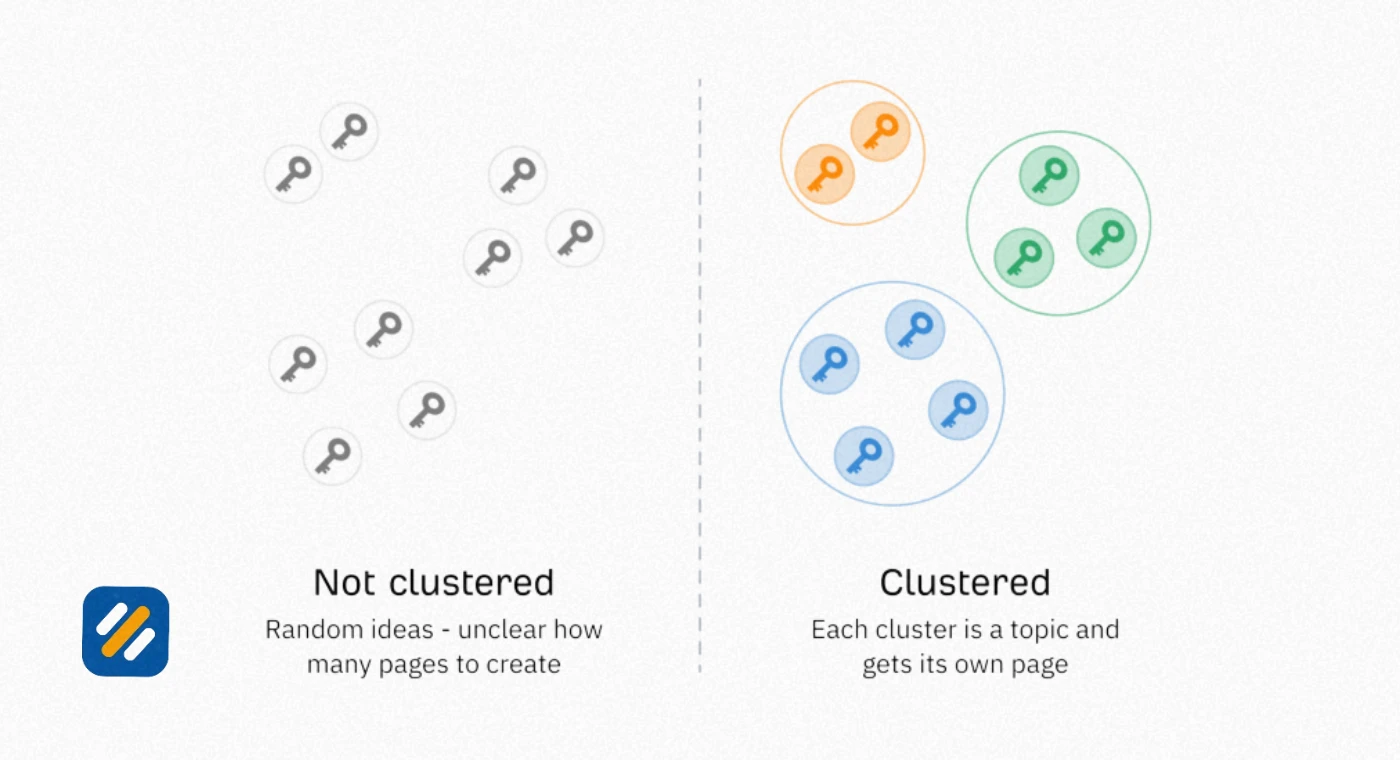
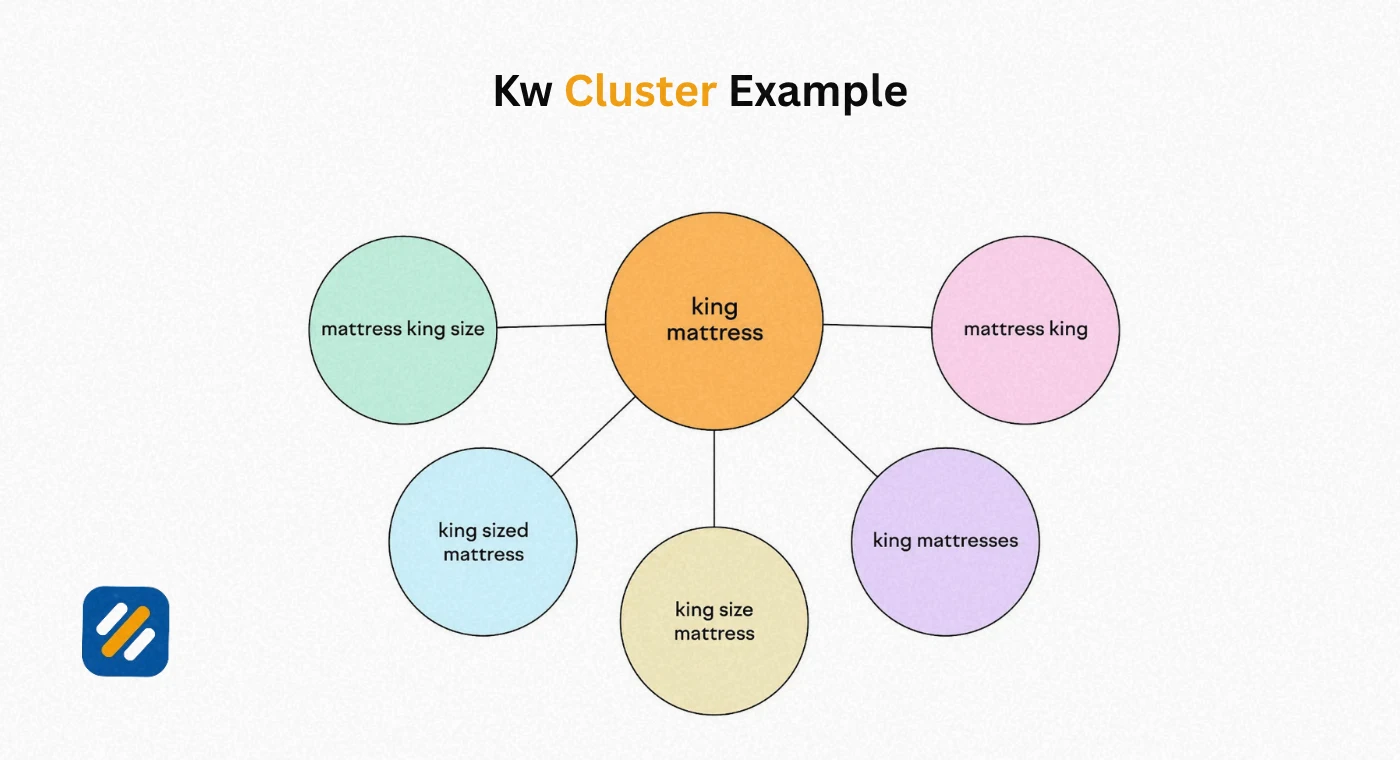
Keyword clustering is the practice of grouping multiple related keywords that share the same search intent and targeting all of them with a single, well-optimised page. Instead of writing ten separate articles for ten variations of the same topic, you write one comprehensive article that ranks for all ten simultaneously.
Here is why this matters more than most guides explain. Google does not rank pages for one keyword. It ranks pages for hundreds of keywords at once, based on how thoroughly and naturally the content addresses a topic. When I optimise a client article properly using keyword clustering, a single page commonly ranks for 50 to 200 related keyword variations within six months. Without clustering, that same effort produces ten separate pages each ranking for one term with a fraction of the combined traffic.
The concept behind keyword clustering is simple. If Google ranks the same set of pages for multiple search queries, those queries share the same or very similar search intent. That means Google already believes one page can serve all those queries. Keyword clustering is simply you recognising and using that fact before Google has to figure it out on its own.
In 2026, this strategy has become even more important because of AI search. When ChatGPT, Perplexity, or Google's AI Overviews pull answers from the web, they favour pages that comprehensively cover a topic rather than pages narrowly focused on one keyword. Keyword clusters naturally produce exactly that kind of comprehensive coverage.
2 Keyword Clustering vs Individual Keyword Targeting | What the Data Shows
Before diving into how to do keyword clustering, it is worth understanding exactly what you gain by switching from a one-keyword-per-page approach to a clustered strategy.
| Factor | Individual Keyword Targeting | Keyword Clustering |
|---|---|---|
| Pages needed for 50 keyword variations | 50 separate pages | 5 to 10 clustered pages |
| Content production time | Very high | Significantly lower |
| Internal linking complexity | Complex to manage at scale | Simpler, fewer pages to connect |
| Google topical authority signal | Weaker, spread across many thin pages | Stronger, concentrated depth per topic |
| Average keywords ranked per page | 1 to 5 | 50 to 300 depending on depth |
| AI Overview eligibility | Lower, single-topic pages often too narrow | Higher, comprehensive clustered pages favoured |
| Risk of keyword cannibalisation | High, multiple pages compete for same intent | Eliminated, one page owns each intent |
| Update and maintenance effort | Very high across many pages | Concentrated, fewer pages to maintain |
The shift in approach is not just about efficiency. It is about how Google actually evaluates content quality in 2026. A page that comprehensively covers a topic from multiple angles demonstrates topical authority. A page that covers one narrow keyword variation demonstrates nothing except that you followed an outdated one-keyword-per-page rule.
3 The 4 Types of Search Intent Every Keyword Cluster Must Be Built Around
Search intent is the foundation of keyword clustering. Get this wrong and you will either merge keywords that should be separate or separate keywords that belong together. Both mistakes cost you rankings.
There are four types of search intent that determine whether keywords belong in the same cluster or different ones
Informational Intent
The searcher wants to learn something. Keywords like "what is keyword clustering," "how does keyword clustering work," and "keyword clustering explained" all share informational intent. A searcher typing any of these wants the same fundamental outcome: to understand what keyword clustering is. They belong in the same cluster and on the same page.
Navigational Intent
The searcher wants to find a specific website or tool. Keywords like "Semrush keyword clustering tool" and "Ahrefs keyword clusters feature" are navigational. Even though they relate to keyword clustering, they should never be grouped with informational keywords because the searcher's goal is completely different.
Commercial Intent
The searcher is comparing options before making a decision. Keywords like "best keyword clustering tools," "keyword clustering tools comparison," and "free keyword clustering software" share commercial intent. These belong together in a cluster targeting a comparison or tools roundup page.
Transactional Intent
The searcher wants to take a specific action. Keywords like "try keyword clustering tool free" or "sign up for Semrush keyword grouping" are transactional. These belong on a landing page, not an informational article.
The critical rule is this: never cluster keywords across different intent types. A page cannot simultaneously serve someone who wants to learn what keyword clustering is and someone who wants to buy a keyword clustering tool. Google understands the difference. Your page structure must reflect it.
4 Keyword Clustering Examples | What Real Clusters Look Like in Practice
Understanding keyword clustering in theory is useful. Seeing real keyword clustering examples makes it immediately actionable.
Here is a real keyword cluster built around the topic of "on-page SEO checklist":
Primary keyword: on-page SEO checklist
Secondary keywords in the same cluster
- on-page SEO checklist for beginners
- on-page optimization checklist
- SEO checklist for blog posts
- on page SEO factors checklist
- on-page SEO audit checklist
- website on-page SEO checklist 2026
All of these keywords share the same informational intent. The searcher in every case wants a structured list of on-page SEO tasks to follow. Google ranks largely the same pages for all of them. One comprehensive article targeting the primary keyword with all secondary keywords naturally included can rank for every single variation.
Here is a second keyword clustering example from the local SEO space:
Primary keyword: local SEO for small businesses
Secondary keywords in the same cluster
- local SEO tips for small business
- how to do local SEO for small business
- local SEO strategy for small business owners
- local SEO guide for small businesses
- small business local search optimisation
Again, every variation shares the same informational intent. One thorough guide targeting "local SEO for small businesses" as the primary keyword, with the secondary variations placed naturally throughout the content, covers the entire cluster.
Here is what these two examples have in common that makes the clustering decision clear
| Signal | What It Tells You |
|---|---|
| Similar SERP results for all variations | Same intent, cluster them |
| Same content format needed for all | One page type serves all variations |
| Same audience at the same stage | No intent mismatch, safe to cluster |
| Minor wording differences between keywords | Classic clustering opportunity |
| Dramatically different content formats needed | Different intents, do not cluster |
| Completely different SERP results | Different intents, create separate pages |
5 How to Build Your Keyword List Before Clustering
Keyword clustering requires a keyword list to work from. The quality of your clusters depends entirely on the quality of your initial keyword research. Here is the exact process I use before clustering any keyword list.
Method 1: Seed Keyword Expansion
Start with three to five broad seed terms that define your topic area. For an SEO blog, seeds might be "keyword research," "on-page SEO," and "technical SEO."
Enter each seed into Google Keyword Planner, Ahrefs free keyword generator, or Semrush Keyword Magic Tool. Export every keyword suggestion with at least 50 monthly searches. For a new website, also filter for keywords with a difficulty score under 30.
You will typically end up with a list of 200 to 500 keywords from this method alone.
Method 2: Competitor Keyword Gap Analysis
Go to Semrush or Ahrefs and enter your top three competitor URLs. Pull their organic keyword rankings and filter for keywords ranking between positions 5 and 20. These are keywords your competitors are almost ranking well for, which means they represent proven search demand in your niche that has not been fully captured yet.
Add these to your master keyword list. Label them as competitor gap keywords so you can prioritise them during clustering.
Method 3: Google People Also Ask Mining
Search your primary seed terms in Google and expand every People Also Ask question on the SERP. Each question is a real search query being asked by real people. These question-format keywords are extremely valuable for clustering because they tend to group naturally around the same informational intent.
Copy every relevant PAA question into your keyword list. These often become the H2 subheadings inside your clustered article, naturally incorporating the keywords into the content structure.
6 How to Do Keyword Clustering | Two Proven Methods
Once you have your keyword list, there are two ways to cluster it. Manual analysis gives you the most control. Automated tools give you speed at scale.
Method 1: Manual SERP-Based Clustering
This is the most accurate clustering method because you are using live Google data rather than a tool's database approximation.
Take two keywords you think might belong in the same cluster. Search both in Google. Compare the top ten results for each. If five or more of the same pages appear in both SERPs, the keywords share the same intent and belong in the same cluster. If fewer than three pages overlap, they have different intents and need separate pages.
Work through your keyword list in pairs and groups, building clusters as you find SERP similarities. Record each cluster in a spreadsheet with the primary keyword as the cluster name and all secondary keywords listed underneath.
This method is time-consuming for large keyword lists but produces the most precise clusters. For a list of 50 to 100 keywords, manual clustering takes two to four hours. For 500 keywords, it takes days.
Method 2: Automated Tool-Based Clustering
For larger keyword lists, automated clustering tools compare SERPs at scale and group keywords algorithmically. Here are the most effective tools for this
| Tool | How It Clusters | Best For | Cost |
|---|---|---|---|
| Ahrefs Keywords Explorer | Groups by Parent Topic using top-ranking page traffic data | Fast clustering of large lists, existing Ahrefs users | Paid plan required |
| Semrush Keyword Strategy Builder | Groups by search intent and SERP similarity | Full keyword strategy workflow, Semrush users | Paid plan required |
| Keyword Insights AI | Compares top 10 SERPs for each keyword | Agency-level clustering of very large lists | Paid per use |
| Google Sheets manual method | SERP overlap tracked manually in spreadsheet | Free option for smaller lists, full control | Free |
| ChatGPT or Claude AI | Groups by topical similarity using AI reasoning | Quick first-pass clustering before SERP verification | Free tier available |
My recommended workflow combines both methods. Use an automated tool for the first pass to create initial groupings at speed. Then manually verify the five to ten most important clusters by checking SERP similarity yourself. This gives you 80% of the speed benefit from automation with the accuracy of manual verification on your highest-priority content.
7 How to Identify the Primary Keyword in Each Cluster
Once your clusters are formed, each one needs a designated primary keyword. This is the keyword your page will be most directly optimised for. Every other keyword in the cluster becomes a secondary keyword.
Here is how to identify the right primary keyword for each cluster
Highest search volume with realistic difficulty. The primary keyword should generally have the highest search volume in the cluster but at a difficulty level your domain can realistically compete for. A keyword with 2,000 monthly searches at KD 15 is a better primary choice for a new site than one with 5,000 searches at KD 55.
Best match to what you want the page to be about. The primary keyword should describe the full scope of the page, not just one narrow angle. If your cluster covers multiple variations of "how to do keyword research for free," the primary keyword is "how to do keyword research for free" not "free keyword research tools" which is more specific.
Appears most naturally in a title tag. Your primary keyword goes in the title tag, H1, and first paragraph. It needs to read naturally in those positions. Sometimes a slightly lower-volume keyword is the better primary choice because it flows more naturally in a headline structure.
Already ranking somewhere on your site. If you have an existing page already ranking between positions 5 and 30 for a keyword, that keyword's cluster is a priority candidate. You already have partial Google trust for that topic. Optimising the existing page with its full cluster can move it significantly in rankings faster than creating something new.
8 How to Use Keyword Clusters to Build Topical Authority
Keyword clustering and topical authority are directly connected strategies. Understanding this connection is what separates an SEO specialist from someone just following a checklist.
Topical authority is Google's assessment of how comprehensively your website covers a specific subject area. A website with 40 articles all deeply covering different aspects of SEO for beginners has stronger topical authority in that niche than a website with 200 articles covering 50 different topics superficially.
Keyword clusters are the building blocks of topical authority. Here is how they connect
Each keyword cluster becomes one article. Each article covers one intent completely. Together, all articles within a topic build a content hub that signals to Google your website is a genuine authority on that subject.
The internal linking structure between clustered articles is what converts individual pieces of content into topical authority. Every article in your SEO for Beginners category should link to every other relevant article in that category. This creates a web of topically related content that Google can follow and assess as a unified body of knowledge.
This is why publishing articles in clusters rather than randomly across topics accelerates authority building. When you publish ten articles all covering different aspects of keyword research before moving to on-page SEO, Google indexes them as a coherent knowledge base on keyword research. Each new article in the cluster strengthens every other article's ranking potential.
9 Keyword Clustering for AI Search | GEO and AIO Optimisation
This is the section that most keyword clustering guides do not cover yet. In 2026, optimising for AI search platforms including Google AI Overviews, ChatGPT, and Perplexity is no longer optional for serious content strategies.
Keyword clustering is uniquely well-suited to AI search optimisation for one simple reason. AI platforms do not rank pages for single keywords. They pull answers from pages that comprehensively cover topics. A clustered page that thoroughly addresses a topic from multiple angles is exactly what AI systems extract from when generating answers.
In AI search terminology, the secondary keywords in your cluster are called fan-out queries. When someone asks ChatGPT a question, the AI breaks that question into multiple sub-queries and searches for information to answer each one. A well-clustered page that naturally covers the primary question and all related sub-questions is far more likely to be cited than a narrow single-keyword page.
To optimise your clustered content for AI search
Answer the primary keyword's question directly in the first two paragraphs. AI systems extract the clearest, most direct answer available. Do not bury your answer after three paragraphs of context.
Use clear H2 and H3 headings that directly state the sub-question being answered. AI systems use heading structure to navigate content and extract specific answers to specific sub-queries.
Include a FAQ section at the end of your clustered article addressing the most common related questions. This directly maps to how AI systems process fan-out queries and significantly increases the likelihood of your content being cited across multiple related searches.
Define key terms clearly and early. AI systems favour content that provides unambiguous definitions because they need to extract and relay those definitions accurately to users.
10 How to Implement Keywords Across a Clustered Page | Placement Guide
Knowing which keywords belong in a cluster is only half the work. Knowing exactly where to place each keyword in the content is what determines whether the page actually ranks for all of them.
Here is the complete keyword placement framework for a clustered page
Primary keyword placement:
- Title tag: within the first four words
- Meta description: in the first sentence
- H1 heading: matches or closely mirrors the title tag
- First paragraph: within the first 100 words
- At least one H2 subheading
- Naturally throughout the body at approximately 1% density
- URL slug: clean, keyword-focused version
Secondary keyword placement:
- Distributed naturally across H2 and H3 subheadings
- Used in body paragraphs where they fit the context naturally
- Included in image alt text where descriptively appropriate
- Woven into the conclusion naturally
What to avoid:
- Forcing secondary keywords into sentences where they sound unnatural
- Using the same secondary keyword in multiple headings
- Repeating the primary keyword in every paragraph
- Adding keywords to sections of content where they are topically irrelevant
The test for every keyword placement is simple. Read the sentence out loud. If the keyword sounds forced or the sentence reads unnaturally, rewrite it until the keyword fits the way a knowledgeable expert would naturally use that phrase in conversation.
11 How to Track Keyword Cluster Performance and Know if It Is Working
Publishing your clustered content is the start, not the finish. Tracking how each cluster performs tells you which pages to update, which clusters to expand, and which are already working well.
Here is the monthly tracking process I use for clustered content
Google Search Console cluster tracking:
Go to Performance then Search Results in GSC. Filter by your URL and look at the full list of queries the page is ranking for. If your clustering was effective, you will see the page ranking for dozens of keyword variations beyond just the primary keyword. A page ranking for 5 or fewer queries after three months is a signal the content needs more depth or the cluster needs to be reconsidered.
Position monitoring for primary keywords:
Track the primary keyword of each cluster in Google Search Console or a rank tracker. Your target is to see the primary keyword move from not ranking to positions 30 to 50 within the first two months, then into positions 10 to 30 by month four, and ideally into the top 10 by month six for low-difficulty keywords.
Click-through rate analysis:
A page ranking in position 8 with a low click-through rate is a priority optimisation target. Improving the title tag and meta description of that page can double its traffic without any change in rankings. GSC shows you CTR for every query. Review this monthly.
Cluster expansion opportunities:
After three to six months, pull the full list of queries each page is ranking for in GSC. Look for new keyword variations appearing that you did not originally include in the cluster. These are organic keyword discoveries that tell you what related queries your page is naturally beginning to rank for. Update the content to address these queries more directly and you will accelerate the ranking gains.
12 3 Expert Tips to Get Better Results From Keyword Clustering
These are the tips that separate average keyword clustering from the kind that builds real authority and lasting rankings.
Expert Tip 1: Always Verify Clusters With a Live SERP Check Before Publishing
Automated clustering tools are fast but imperfect. Before you finalise any cluster, manually Google the primary keyword and two or three of the secondary keywords. Confirm the same pages appear in the top ten results. If completely different pages dominate for one of your secondary keywords, it does not belong in that cluster regardless of what the tool suggested. A ten-minute manual verification before publishing saves you from building an article around a flawed cluster that will never rank for all the keywords you intended.
Expert Tip 2: Build Your Clusters Around Search Intent First, Volume Second
Most beginners build clusters by grouping similar-sounding keywords together. The right way is to group by search intent first and check volume second. Two keywords can look completely different on the surface but share identical intent and belong in the same cluster. Two keywords can look nearly identical but serve different intents and need separate pages. Intent is what Google optimises for. Your clustering must match that logic or your rankings will never reach their potential.
Expert Tip 3: Revisit and Expand Clusters Every Six Months
A keyword cluster is not a one-time decision. Search behaviour evolves, new related queries emerge, and Google begins ranking your page for terms you never originally targeted. Every six months, pull the full list of queries each of your top pages ranks for in Google Search Console. You will almost always find new keyword variations worth adding to the page. Updating your content to address these emerging queries directly is one of the highest-return SEO activities you can do on existing content.
13 Conclusion
Keyword clustering is not a tactic. It is a fundamental shift in how you think about content and SEO strategy.
When you stop writing one page for one keyword and start building comprehensive pages that own entire keyword clusters, you produce less content that drives more traffic, builds stronger topical authority, and remains competitive for longer without constant updates.
The process is straightforward. Build your keyword list. Identify search intent for every term. Group keywords by shared intent. Select the primary keyword for each cluster. Write one comprehensive, deeply useful page per cluster. Track performance and expand over time.
Every major SEO authority website you admire, from Ahrefs to Semrush to Backlinko, is built on this principle. They do not publish one thin article per keyword. They publish comprehensive cluster pages that dominate an entire topic area.
That is the standard you are now building toward on SEOWithRoman.com. One cluster at a time.
Have a question about keyword clustering for your specific niche? Drop a comment below and I will answer it personally.
Join 1,000+ business owners and bloggers who get one actionable SEO tip every week — straight to their inbox. Free forever.
Get Free Weekly Tips →